Carmel Isn't One Real Estate Market. It's At Least Four of Them.
August 27, 2026
August 27, 2026
A buyer touring a listing on Mesa Drive assumes she is looking at a Carmel-by-the-Sea address. The listing says Carmel. The zip code, 93923, is the same one stamped on postcards from the village three blocks from the beach. Then her agent mentions that if she ever needs a deputy at 2 a.m., the response comes from the Monterey County Sheriff's Office, not the Carmel Police Department across town on Junipero Avenue. She is not in the city. She is in Hatton Fields, an unincorporated pocket of the county that borrows Carmel's name and zip code but not its municipal government.
This surprises more buyers than it should. "Carmel" on a listing sheet is doing a lot of work it was never built to do. It covers a one-square-mile incorporated city with its own police force, its own building department, and a downtown grid so committed to its founders' original vision that it still has no house-to-house mail delivery. It also covers a ring of unincorporated county neighborhoods, Carmel Woods, Hatton Fields, Mission Fields, Mission Tract, Carmel Point, and Carmel Hills, that fall under what planners call Carmel-by-the-Sea's sphere of influence: geographically adjacent, culturally attached, but governed and served by Monterey County rather than the city itself. If you are comparing neighborhoods with "Carmel" in the name, the first useful question is not the median price. It is which government actually shows up when you call.
The sphere-of-influence areas are officially part of unincorporated Monterey County, which is responsible for law enforcement, street repairs, and public transit in those pockets, even though they sit right against the city line and share its zip code. The Monterey County Sheriff's Office runs this coverage out of its Coastal Station on Aguajito Road in Monterey, and its own materials describe the station's territory as the unincorporated county areas of Pebble Beach, Carmel, Carmel Valley, and Big Sur. Inside the city limits, a separate department, the Carmel Police Department, handles calls from an office on Junipero Avenue. Two agencies, one shared name.
This is not a trivia point. It shapes daily texture in small but real ways. Downtown Carmel-by-the-Sea addresses are still built around cross streets rather than house numbers, a quirk tied to the city's early decision to route mail through a central post office instead of door delivery. Step outside the city line into Hatton Fields or Mission Fields and you are back to ordinary street numbers, curbside mail, and county road maintenance. A buyer chasing the postcard version of Carmel, the walkable grid with no visible street signs, needs to confirm they are actually inside the one square mile that produces it. A buyer who wants more land and doesn't mind a normal mailing address has several better-suited options just outside it.
Once you separate the city from its unincorporated neighbors, the differences in what your money buys become sharper. Here is how four of the most commonly searched "Carmel" neighborhoods compare on origin, lot size, and jurisdiction.
| Neighborhood | Origin | Typical lot size | Jurisdiction |
|---|---|---|---|
| Hatton Fields | Platted starting in 1925, when Paul Flanders purchased 233 acres from the Hatton estate through his newly formed Carmel Land Company | Roughly 0.30 to 1.28 acres, among the largest residential parcels in Carmel | Unincorporated Monterey County |
| Carmel Point | Developed as the Walker Tract on the former Martin Ranch | Often under a quarter acre; one recent listing sat on a 5,200-square-foot lot | Unincorporated Monterey County |
| Carmel Woods | A 125-acre tract platted on the north side of the city between 1922 and 1925 | Forested lots, commonly around a fifth of an acre | Unincorporated Monterey County |
| Carmel Highlands | Cliffside enclave south of the city, built around ocean bluffs | Varies widely, often smaller lots commanding view premiums | Unincorporated Monterey County |
Every one of these sits outside city hall's jurisdiction. That single fact groups them together for law enforcement and road maintenance purposes even though their housing stock, lot economics, and pace of sales have almost nothing in common with each other.
Here is where the blended "Carmel" number starts to mislead. Over the three months ending June 2026, the citywide Carmel market moved at a genuine clip: a median sale price of $3.2 million, up 13.1 percent year over year, homes averaging 17 days on market compared with 14 days a year earlier, and 31 homes sold in June 2026 against 24 the prior June. That reads like a market with real momentum, and for the busiest pockets of the city, it is.
Carmel Woods tells a different story depending on which month you catch it. In January 2026, its median sale price stood at $3.0 million, up 14.6 percent year over year, on just four closed sales. By May 2026, that median had dropped to roughly $2.47 million, down 25 percent year over year. Nothing structural changed about Carmel Woods between January and May. What changed was which handful of houses happened to close. In a neighborhood selling a few homes a month, the median isn't a trend line. It's a snapshot that shifts hard every time one large or small sale rolls through.
Carmel Highlands runs even thinner. Recent published figures put its median sale price at roughly $2.8 million, down 33 percent year over year, with homes averaging 92 days on market and only a handful of active listings at any given time. Compare that pace to the 17-day citywide average and it's clear the Highlands isn't a slower version of the same market. It's a different market wearing the same name, one where a single view-lot estate or a single distressed sale can swing the published median by hundreds of thousands of dollars.
This is the real lesson underneath the number. When a portal shows you "Carmel median price," it is quietly averaging a brisk in-town market, a volatile forested pocket, and a thin cliffside enclave into one figure that describes none of them accurately. Anyone comparing neighborhoods needs to ask for the number at the neighborhood level, not the zip code level, before drawing conclusions about value or timing.
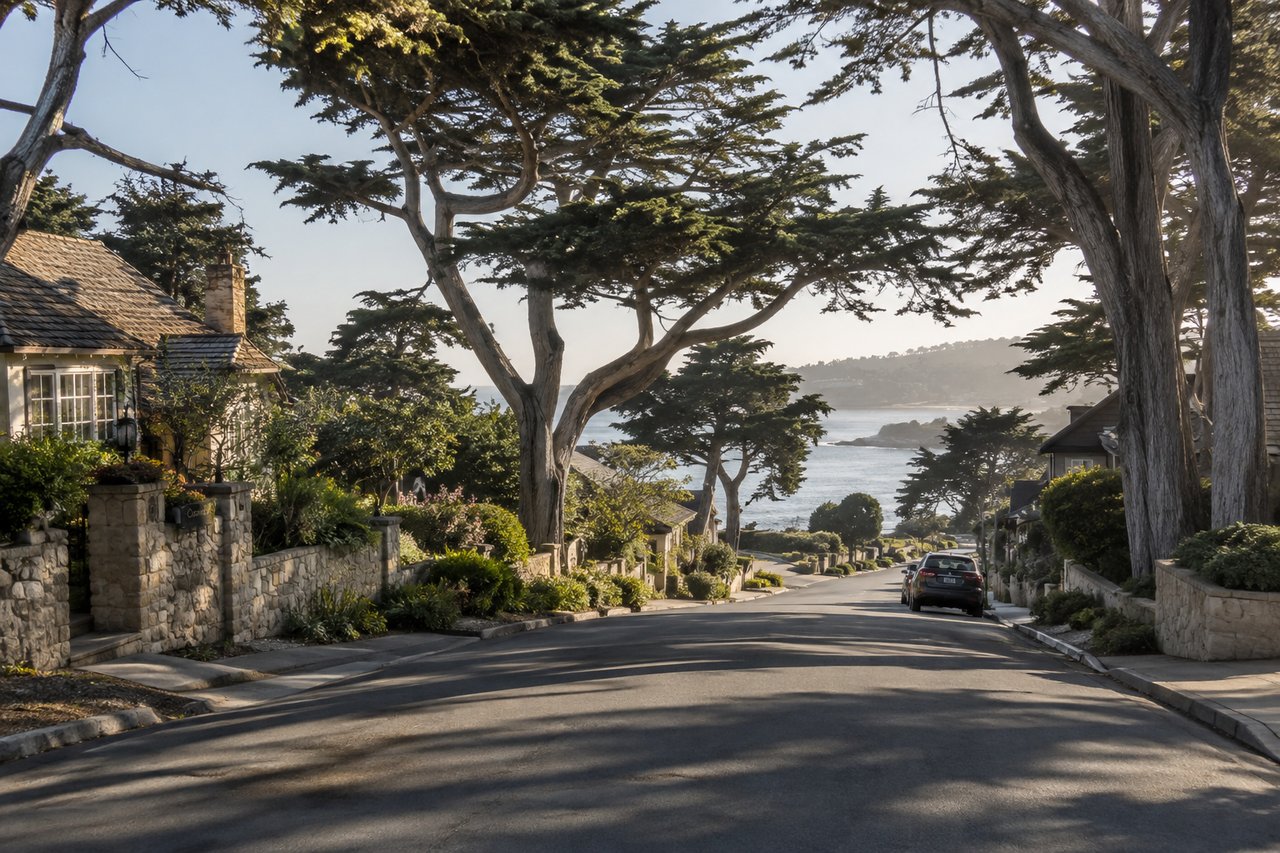
The physical trade-off between these pockets is as sharp as the pricing one. Hatton Fields sits inland, bounded by Highway 1 to the east, Hatton Canyon to the north and west, and Rio Road to the south, with parcels large enough that the neighborhood still reads as spacious by Carmel standards. It backs directly onto the Mission Trail Nature Preserve, with immediate access to five named paths, Flanders, Doolittle, Willow, Mesa, and Serra, that wind through pine and redwood forest. Buyers drawn to Hatton Fields are usually trading distance from the beach for room to spread out and a quieter, tree-lined street.
Carmel Point offers close to the opposite bargain. Lots here often run under a quarter acre, sometimes as tight as 5,200 square feet, with homes separated by hedges and picket fences rather than open ground. What you give up in acreage you get back in proximity. Carmel Beach forms the neighborhood's western edge, and Carmel River State Beach, a quieter mile-long stretch popular with birdwatchers, sits just beyond it. Current asking prices reflect that gap plainly: active Hatton Fields listings have recently averaged around $3.4 million, while active Carmel Point listings have averaged closer to $8.4 million. That is not simply a "better neighborhood" premium. It is the market pricing square feet of forested land against square feet of walking distance to sand, two different products that both happen to carry the word Carmel.
Does a "Carmel" zip code guarantee I'm inside the incorporated city? No. The 93923 zip code extends well beyond city limits into unincorporated pockets like Hatton Fields, Mission Fields, Carmel Woods, and Carmel Point. Confirm the parcel's actual jurisdiction rather than assuming from the address alone.
Who responds if I have a public safety issue? It depends on the parcel. Inside city limits, the Carmel Police Department responds. Outside city limits, in any of the sphere-of-influence neighborhoods, the call routes to the Monterey County Sheriff's Coastal Station.
Is a bigger lot always the better value in these neighborhoods? Not necessarily. Hatton Fields offers more land per dollar, but Carmel Point's smaller lots carry a premium tied to beach proximity that acreage alone doesn't replace. The right trade-off depends on whether daily walkability to the water or physical space around the house matters more to how you plan to live there.
If you are weighing a move into one of these Carmel pockets and want the jurisdiction, the lot economics, and the current pace of each neighborhood laid out plainly before you write an offer, Ben Ottmar has spent years working these exact micro-markets from the inside. Get in touch and let's figure out which version of Carmel actually fits what you're looking for.
Educational
Twenty years of working with these buyers points to six recurring patterns — and by the time most of them call an agent, they already know which city, and sometimes wh… Read more

Educational
A dated, sourced look at the September–November 2026 events calendar and current mortgage rates, and what the fall season typically means for Peninsula buyers and sell… Read more
I combine local market expertise, strategic guidance, and dedicated service to help you make informed decisions and achieve successful outcomes.
BAY HOMES & ESTATES
719 LIGHTHOUSE AVE PACIFIC GROVE, CA 93950 Ottmar, Benjamin David | CA DRE# 01503930 Frangella, James Michael | CA DRE# 01062212