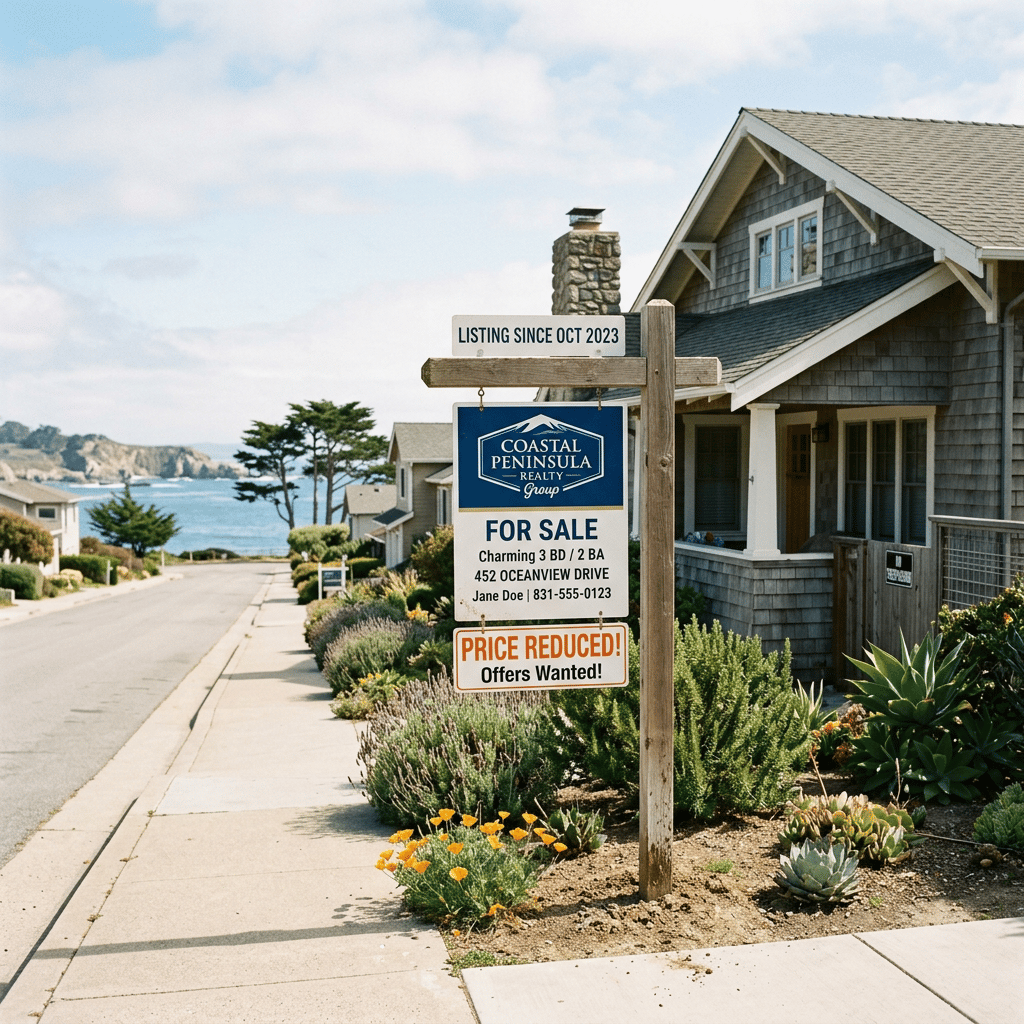
Your Monterey Peninsula Home Hasn’t Sold Yet — Should You Rent It Out Instead?
April 5, 2026
April 5, 2026
If your Monterey Peninsula listing has been sitting longer than you expected, it’s normal to start thinking: Should I rent it out and try selling later?
That “backup plan” is happening more often nationwide. Zillow recently reported that 2.3% of homes listed for rent on Zillow had been listed for sale recently—one of the highest readings in Zillow’s nearly six-year record.
But before you become an “accidental landlord,” it’s worth slowing down. On the Monterey Peninsula (Monterey, Pacific Grove, Carmel-by-the-Sea, Carmel Valley, Pebble Beach, Seaside, Marina, Sand City, Del Rey Oaks), the rent-vs-sell decision often comes down to realistic rent, management logistics, and California tenant rules—not just frustration with days on market.
Start with the practical “fit.”
A home that rents easily in one pocket of the Peninsula may be tougher in another depending on:
Ask yourself:
Don’t guess. Look at:
If the rent you could command won’t cover the “real costs” below, renting may only delay the problem.
Renting can look like passive income on paper. In reality, it’s a job—unless you hire it out.
Be honest about whether you’re ready for:
If that sounds miserable, renting “for now” can become a longer, more stressful detour than simply repositioning the listing to sell.

Here’s a simple “accidental landlord” cost checklist sellers on the Peninsula should run:
Landlord (dwelling) policies often cost more than owner-occupied homeowners insurance—commonly cited in the ~15–25% range depending on property and risk factors.
Many owners choose management if they’re out of the area. A common ballpark is around 8–12% of monthly rent, though it varies by services and market (leasing fee, renewals, inspections, etc.).
Plan for:
Even good rentals can sit vacant between tenants. Those gaps matter if you’re still carrying:
California’s Tenant Protection Act (AB 1482) sets a statewide baseline for many rentals, including limits on annual rent increases and “just cause” eviction requirements once a tenant has been in place long enough—with important exemptions.
(If you’re considering renting, it’s smart to review how this applies to your specific property type with qualified advice.)
Before switching strategies, it’s often worth doing a focused reset—because the issue isn’t always “no buyers.” On the Monterey Peninsula, it’s frequently one (or more) of these:
A well-executed reposition can be cheaper—and far less complicated—than becoming a landlord.
Renting your unsold home can be the right move if:
But if renting is just a reaction to a slow sale, it’s worth evaluating whether a pricing/presentation/marketing reset gets you to the original goal faster—with fewer long-term obligations.
Sometimes—but “temporary” can turn into multiple years if the numbers are thin or tenant turnover is hard. Run the full cost sheet first.
It can. Tenant occupancy can limit showing flexibility and affect buyer pool, and you may have additional legal steps depending on the situation.
No. AB 1482 has exemptions (for example, some newer construction and certain owner-occupied situations). Confirm applicability for your exact property.

Educational
HOA realities, how short-term rental rules actually differ city by city, property tax reassessment, and wildfire insurance and AB 38 — the groundwork that applies no m… Read more




Educational
Twenty years of working with these buyers points to six recurring patterns — and by the time most of them call an agent, they already know which city, and sometimes wh… Read more

I combine local market expertise, strategic guidance, and dedicated service to help you make informed decisions and achieve successful outcomes.

BAY HOMES & ESTATES
719 LIGHTHOUSE AVE PACIFIC GROVE, CA 93950 Ottmar, Benjamin David | CA DRE# 01503930 Frangella, James Michael | CA DRE# 01062212